

An environmental impact assessment (EIA) evaluates the damaging effects of a plan, policy, program, or actual project on the environment before the decision is made to move forward with the suggested action.
Before deciding whether to proceed with a planned action, a plan, policy, program, or an actual project, it’s a must to undergo an environmental assessment.
SEA, strategic environmental assessment uses the same principles as EIA, environmental impact assessment. SEA covers a more broad area and is less detailed than EIA.
Strategic environmental assessments consider the environment and other sustainable factors like the economy or society. It is a tool for environmental management that is used in the approval and decision-making processes for projects.
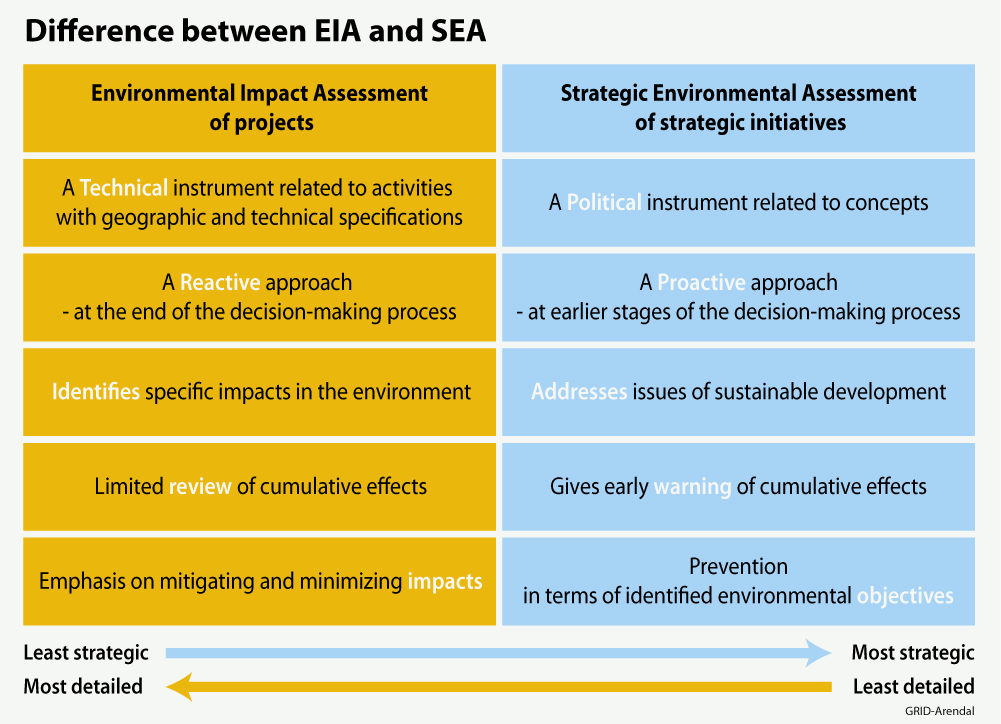
Environmental Impact Assessment aims to provide the decision-makers and planners for a project with an in-depth understanding of the overall effects the environment is expected to have. This information in turn helps the planners whether to go ahead with the project or give it up.
An Environmental Impact Statement (EIS) is an EIA but on a more comprehensive and detailed scale. EIA just helps the decision-makers to decide whether or not to select a particular project or not. EIS has all the details of an EIA and also feedback from people who would be direct or indirect beneficiaries of the project.
An EIS also entails alternatives to the proposed project, policy, program or plan and has the details of their environmental impact.
The EIS is a more detailed EIA, whereas the SEA is a more comprehensive, but not necessarily detailed, EIA. EIA will provide you with a basic understanding of the environmental impact of your program or plan. SEA will tell you what it is doing to the environment as well as the impact on the economy and people’s lives in that area. EIS will inform you of the environmental impact of your program, consumer opinions, proposed alternatives, and their environmental impact.
EIA and SEA can be performed in our regular day-to-day activities. If you were making an order at a restaurant and you have a budget you don’t plan to exceed but you still wish to treat yourself to something nice. Your budget as a determining factor makes it SEA. If you were a detailed and analytical person (like me) that goes as far as considering how the food was made and the amount of waste generated while making the food and use that knowledge to choose what food on the menu you would go for, that is EIA. The belief is that the lesser the amount of that food consumed, the lesser waste is generated for that restaurant. The lesser the negative impact it has on the environment.
EIS is also useful in everyday situations. If you went to the grocery store to buy milk and didn’t have a specific brand in mind, you’d probably ask for recommendations from someone who works there or someone who buys similarly to you. You will compare the various brands to find the best quality at the lowest price. The expiry date of the milk (for fresh milk) and the contents of the milk are two things you’d look out for. If you consider things like milk packaging to determine which best protects environmental health, all of the following procedures could be considered EIS.
Conclusion
Environmental Impact Assessment evaluates the damaging effects of a plan, policy, program, or actual project on the environment before the decision is made to move forward with the suggested action.
Strategic Environmental Assessment covers the same scope as EIA and also considers other scopes such as the economic or social impact of such a project. SEA is usually broader but less detail-oriented compared to an EIA.
Environmental Impact Statement is a more detailed EIA. It contains information such as consumer feedback, alternative projects and their environmental impact.
EIA, SEA, and EIS assist in making more informed and near-perfect environmental decisions. Incorporating them into our daily lives can help us make better decisions while also caring for the environment.


 Jay water advisory
Leave a comment