Hydrogen is a chemical substance with the symbol H and an atomic number of 1. It is the most abundant chemical substance on earth, constituting about 75% of all matter. Hydrogen is usually found in combination with other substances. Although hydrogen is one of the most abundant chemical substances, it takes up only 0.14% of the earth’s crust by weight.
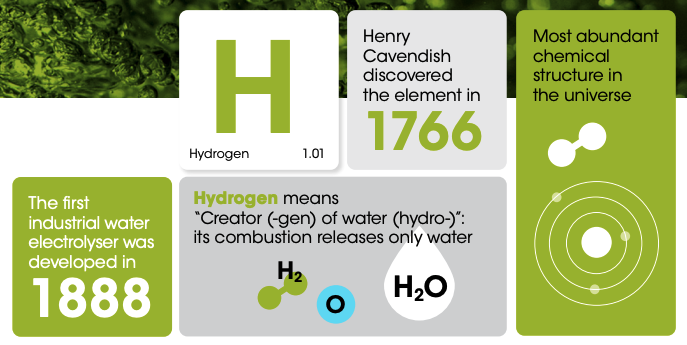
Hydrogen as a gas is not easily obtained in nature. As a result, numerous processes are used to create hydrogen gas. The different colours for hydrogen are named from the manufacturing method and may range from region to region.
Hydrogen gas has a wide range of applications, from commercial to personal or domestic. Hydrogen may be used in power plants, as a coolant in factories, in weather balloons, and in the manufacturing of ammonia, which is used in fertilizers.
Apart from the most well-known colours of green, blue, and grey, hydrogen gas may be identified with six more colours: brown or black, turquoise, purple, pink, red, and white.

Green hydrogen
Green hydrogen, also known as clean hydrogen, is generated by electrolyzing water molecules to separate hydrogen and oxygen using renewable energy such as wind or sun. It is termed green because there are no carbon dioxide emissions throughout the production process.
Green hydrogen costs twice as much as regular hydrogen and blue hydrogen. The cost of green hydrogen is determined by the cost of power, technology, and storage in the area. Although the cost of renewable energy and electrolysis equipment is decreasing, green hydrogen may not get considerably cheaper because of the high cost of the technology involved.

Blue hydrogen
Blue hydrogen is generated from fossil fuels such as methane or coal using heat, steam, and pressure. The carbon generated during the process is captured and stored underground through industrial carbon capture and storage (CSS).
Production of blue hydrogen often requires a lot of energy, and it is not sustainable. The production costs and the water requirements depend on the technology employed in the production.
Grey hydrogen
Grey hydrogen is generated similarly to blue hydrogen, except unlike blue hydrogen, the carbon dioxide emitted during the creation process is not collected.
Turquoise hydrogen
Another kind of hydrogen that can be described to offer clean hydrogen is turquoise hydrogen. Turquoise hydrogen is developed by a process known as methane pyrolysis, which generates solid carbon and hydrogen gas. The solid carbon produced can be utilized to make tyres or as a soil improver.

Yellow hydrogen
Yellow hydrogen is produced through electrolysis using solar energy. It can be argued that yellow hydrogen is another type of green energy on the hydrogen spectrum.
Brown or black hydrogen
Brown hydrogen is produced from bituminous coal, while brown hydrogen is produced from lignite coal through the gasification process. The production process is quite polluting because it involves turning coal into gas, which releases a lot of CO2 into the atmosphere.
Pink hydrogen
Pink hydrogen, also known as red or purple hydrogen, is similar to green hydrogen in that they are both produced through the process of electrolysis, but while green hydrogen is produced with renewable energy, pink hydrogen is produced using nuclear energy. Since nuclear energy has low carbon and water has no carbon, the entire production process has little to no carbon in it. Radioactive waste is a byproduct of the production process of pink hydrogen, and this hurts the environment.
White hydrogen
White hydrogen occurs naturally. It is not developed in the laboratory, unlike other gases, but it is found as a free gas either in layers of the continental crust, deep in the oceanic crust, in volcanic gases, in geysers, or in hydrothermal systems.
Conclusion
- The production process of hydrogen gas determines its name.
- Although hydrogen is abundant in nature, laboratory production of hydrogen gas is required.
- Using the right type of hydrogen gas can help achieve net zero.
- Energy gotten from hydrogen gas is the only available energy that produces water, electricity, and heat when consumed in a fuel cell.
 Jay water advisory
Leave a comment