By Jay Water Advisory
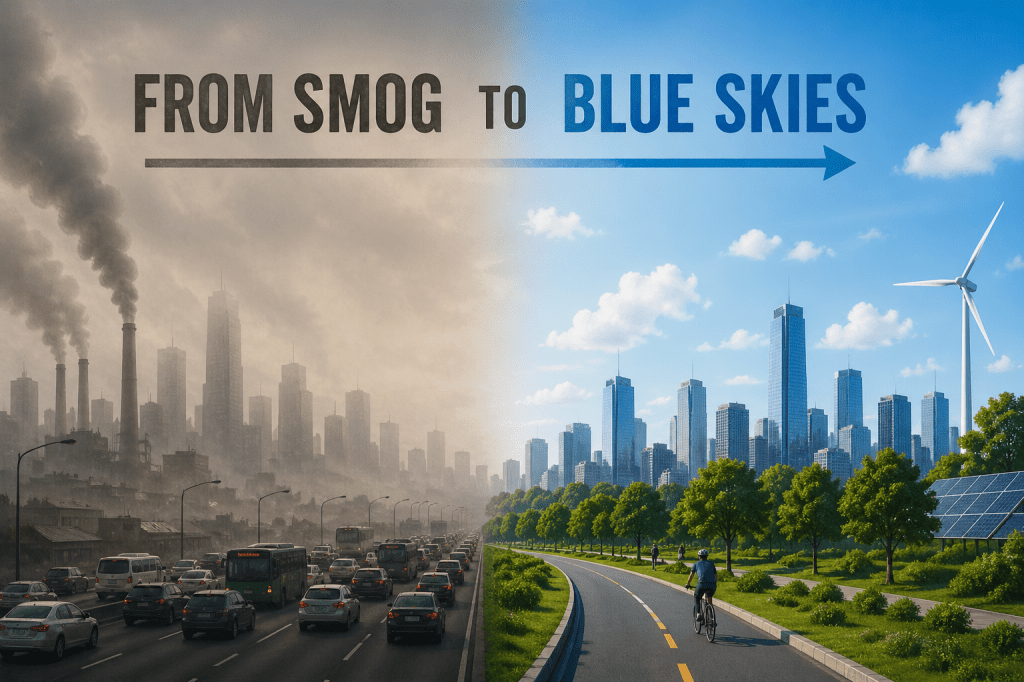
In the winter of 2013, Beijing made international headlines for all the wrong reasons. The city was blanketed in a dense, grey smog so thick that flights were cancelled, schools were closed, and residents were advised not to go outside. Air quality monitors reported PM2.5 levels — fine particulate matter, the most dangerous kind — of over 700 micrograms per cubic metre. The WHO safe annual guideline is 5. China’s own national standard was 35. Beijing was recording concentrations twenty times that in a single day.
That was twelve years ago. Today, Beijing recorded just two heavily polluted days in all of 2024, compared with 58 in 2013. The number of days with good air quality reached 290 — the highest on record. The United Nations Environment Programme has called it the “Beijing Miracle.”
How did China do it? And what, if anything, does it mean for Nigeria?
Table of Content
- The Scale of Nigeria’s Air Quality Problem
- What China Did — and How It Worked
- What Nigeria Can Adopt — at the National Level
- What You Can Do — as an Individual
- A Final Note on What China’s Story Really Teaches
The Scale of Nigeria’s Air Quality Problem
Before drawing lessons, it is worth understanding what Nigeria is actually dealing with.
The average annual PM2.5 concentration in Nigeria is almost ten times higher than the WHO recommended level of 5 micrograms per cubic metre. In Lagos, levels routinely reach 68–78 micrograms per cubic metre. This places the city in the same pollution range as the old Beijing. Air pollution caused an estimated 11,200 premature deaths in Lagos alone in 2018, the highest in West Africa, and cost the city approximately $2.1 billion — representing 2.1% of Lagos State’s GDP. Children under five accounted for 60% of those deaths.
The primary culprits are well-documented. Road transport is the single largest source of PM2.5 in Lagos, driven by a vehicle fleet where most cars are over 15 years old, running on fuel with sulfur levels 200 times higher than US standards. Industrial emissions from cement, steel, chemicals, and refinery operations in areas like Apapa, Ikeja, and Odogunyan compound the problem significantly.
And then there is the factor unique to Nigeria: generators. Approximately half of Lagos total energy demand is met by diesel and gasoline generators. These run in closer proximity to people than any industrial source — humming in compounds, offices, and markets — making their pollution disproportionately harmful. Open burning of waste, a consequence of inadequate solid waste management, and the burning of biomass fuels for cooking add further layers to a deeply stressed air environment.
The harmattan season overlays an additional natural burden — dust from the Sahara mixing with all of these man-made emissions to create a particularly toxic seasonal cocktail.
What China Did — and How It Worked
China’s transformation did not happen by accident or gradually. It was the result of deliberate, sustained, and enforceable national policy decisions made at the highest level. In 2014, Prime Minister Li Keqiang declared an all-out war on air pollution. What followed was one of the most aggressive environmental policy interventions of the 21st century.
1. Binding, Measurable Targets
The Action Plan on Air Pollution Prevention and Control, released in 2013, set binding commitments tied to specific deadlines and attached to local government performance reviews. Officials who failed to meet targets faced real consequences. By 2022, particulate pollution in China had declined 41% from 2013 levels. In Beijing specifically, PM2.5 concentrations fell 54% between 2012 and 2020. Because of these improvements, the average Chinese citizen can now expect to live two years longer than they would under 2013 pollution conditions.
2. Aggressive Coal Phase-Out and Renewable Energy Investment
Coal was the engine of China’s industrial growth and the primary driver of its air pollution. Beijing’s coal consumption plummeted from 21.8 million tonnes in 2012 to under 600,000 tonnes in 2024 — a reduction of over 97% in twelve years. Nationally, China invested in renewables at an extraordinary scale. In 2024, China spent $625 billion on clean energy — 31% of the entire global total. Wind and solar electricity generation rose 25% in 2024 alone, and by early 2025, combined wind and solar capacity had overtaken coal capacity for the first time.
3. Industrial Restructuring
Beijing closed over 3,000 manufacturing and polluting enterprises and rectified more than 12,000 disorganised or polluting businesses. Ultra-low emission standards were introduced for coal-fired power plants, requiring PM, SO₂, and NOₓ concentrations equivalent to those from gas turbines. Industries that could not meet the new standards were shut down or relocated.
4. Transforming Transportation
Over 3 million high-pollution vehicles were phased out in Beijing. The city simultaneously invested massively in metro and public transit infrastructure, reducing reliance on private vehicles. Electric buses and new energy vehicles were promoted aggressively, with NEVs now exceeding 1 million registered in Beijing alone.
5. Regional Coordination
China recognised early that air pollution does not respect city boundaries. Research shows that 64% of Beijing’s pollution is actually transported in from neighbouring provinces, primarily from Hebei and Tianjin. The response was to coordinate pollution control across entire regional clusters with shared targets, shared monitoring, and shared accountability.
6. Real-Time Air Quality Monitoring
China built one of the world’s most extensive ambient air quality monitoring networks, making real-time data publicly available. When citizens can see the numbers, governments are held accountable for them. Public pressure became a driver of policy enforcement, and the data infrastructure made it impossible to dispute progress or the lack of it.
What Nigeria Can Adopt — at the National Level
China’s path cannot be transplanted directly into Nigeria. The two countries have different economies, governance structures, and starting positions. But the principles behind China’s success are transferable, and several specific interventions are directly applicable.
Set binding, enforceable air quality targets. Nigeria has environmental policies. What it largely lacks is enforcement. China’s lesson is that aspirational guidelines accomplish little without binding targets, monitoring, and real consequences for non-compliance. Nigeria’s National Environmental Standards and Regulations Enforcement Agency (NESREA) needs teeth — and the political will behind those teeth.
Address the generator economy. China addressed its coal dependence by making alternatives accessible and ultimately cheaper. Nigeria’s path with generators runs along the same logic. The good news is that alternatives are already emerging and growing more affordable in Nigeria. Solar rechargeable fans, LED solar lights, and solar lanterns are widely available in Nigerian markets and on platforms like Jumia at accessible price points. For households whose primary generator use is lighting and a fan, these alternatives can eliminate that use entirely.
For households or businesses that depend on a freezer, solar freezers are a confirmed Nigerian reality. Koolboks, a company with a local assembly plant in Lagos, produces solar-powered freezers on a pay-as-you-go lease-to-own model, cutting the cost of off-grid refrigeration by 40% and making ownership accessible without large upfront costs. The EasyFreeze by Amped Innovation was specifically designed for unreliable grid environments like Nigeria’s. Solar freezers in Nigeria currently range from approximately ₦150,000 to ₦600,000, depending its on capacity. For a small business owner running a freezer on a generator, the fuel savings alone can offset that cost within a year.
Inverter systems connected to solar panels remain the most comprehensive generator replacement for households that can afford the upfront investment. But the spectrum of options is now broad enough that almost any household can find a starting point. The principle is simple: every generator hour replaced by a solar alternative is pollution that does not enter your neighbourhood’s air.
Enforce fuel quality standards. Nigeria lowered diesel sulfur standards in 2017, but enforcement remains inconsistent. Fuel in Lagos still contains sulfur levels 200 times higher than US standards. This is not a regulatory gap — it is an enforcement gap. Strictly enforcing existing fuel quality standards would reduce vehicle emissions significantly without requiring new legislation.
Invest in public transport infrastructure — and learn from what is already being done. Lagos’s road transport is the single largest PM2.5 source in the city, driven by 227 vehicles per kilometre of road and an average commute time of four hours per day. Nigeria is beginning to move in the right direction, and there are genuinely encouraging developments happening right now.
The Presidential Initiative on Compressed Natural Gas (Pi-CNG) is a national programme that has already converted over 100,000 vehicles, deployed CNG buses across multiple states, and expanded to 23 states with 337 certified conversion centres. The initiative was launched in Ibadan in September 2024, with 20 CNG buses handed over to Oyo State’s Pacesetter Transport Service, before being rolled out to Lagos, Kwara, and Abuja. Oyo State has since received a total of 30 CNG buses, with the Ibadan-to-Abuja routes already operational as of 2025. Lagos State, through LAMATA, is running pilot demonstration schemes for both CNG and electric buses, with over 520,000 passengers already transported on the CNG pilot.
Is CNG actually better for air quality? The answer is a qualified yes. Compared to petrol, CNG emits 20–25% less CO₂, up to 90% fewer particulate matter emissions, and significantly lower sulfur and carbon monoxide levels. For city buses previously running on diesel, the particulate matter reduction is especially significant for urban air quality. The cost benefit is equally real; one driver in Oyo State reported his monthly fuel bill dropping from ₦250,000 to ₦26,000 after converting to CNG. CNG is still a fossil fuel, and some NOx emissions may increase slightly compared to petrol — it is a meaningful step forward, not a perfect solution. Electric vehicles powered by renewable energy remain the cleaner long-term goal.
Stop open waste burning. Over 30% of Lagos’s estimated 14,000 tonnes of daily waste ends up at illegal dump sites, much of it burned. China addressed open burning through better waste management infrastructure combined with enforcement. Nigeria’s path here runs through the solid waste management improvements — reducing waste generation, improving collection, and making burning unnecessary rather than simply prohibiting it.
Build air quality monitoring infrastructure. You cannot manage what you cannot measure. Nigeria needs a robust, publicly accessible network of air quality monitors in its major cities producing real-time data. The Clean Air Fund’s work in Lagos represents a step in this direction. It needs to be expanded and institutionalised so that citizens, researchers, and policymakers can all see the numbers and act on them.
What You Can Do — as an Individual
National policy change is essential but slow. Individuals are not powerless in the meantime.
Explore solar alternatives for specific needs. You do not need a full solar installation to start. Solar rechargeable fans and LED lights are widely available in Nigerian markets and online. If you or a family member runs a small business dependent on a freezer, solar freezers are now commercially available in Nigeria with a pay-as-you-go model that removes the barrier of upfront cost. Start with one solar alternative for your highest-use application, and build from there. Every reduction in generator hours is a direct air quality benefit for your household and neighbours.
Reduce overall generator use. Beyond solar alternatives, simply reducing generator hours during periods when it is not critical — sleeping hours, low-demand periods — makes a measurable local difference. Running a generator for essentials rather than continuously cuts both your fuel costs and the pollution your household contributes to the surrounding air.
Use CNG transport where available. If you live or work in Lagos, Ibadan, Abuja, or any of the 23 states where the Pi-CNG programme has expanded, choosing CNG-powered buses over older vehicles when available is a direct individual contribution to better urban air quality. It also sends a market signal that demand for cleaner transport exists.
Avoid open burning. Do not burn waste in your compound or on the street. Separate recyclables and compostable material and reduce the volume that ends up in a bin. What does not go to a bin cannot end up being burned.
Choose cleaner cooking methods. Kerosene stoves and open charcoal cooking are significant sources of indoor and outdoor air pollution. Where financially accessible, LPG (cooking gas) produces significantly fewer particulate emissions and is a meaningful improvement for household air quality.
Protect yourself during high-pollution periods. During peak traffic hours, industrial activity, or harmattan, wear a mask rated for PM2.5 filtration when spending extended periods outdoors. Keep windows closed during peak pollution periods and, if possible, use air purifiers indoors.
Advocate and report. Report illegal waste burning to local authorities. Engage local government on air quality issues. Support organisations working on clean air advocacy in Nigeria. Public pressure was a critical driver of China’s environmental accountability — it can be in Nigeria too.
A Final Note on What China’s Story Really Teaches
The Beijing Miracle is real, and it is genuinely impressive. But it is also instructive about what it required: political will at the highest level, sustained over more than a decade, with real enforcement, real investment, and the honesty to acknowledge when implementation falls short.
Progress that looked impossible in 2013 looked inevitable by 2024 — not because the problem solved itself, but because the right decisions were made and consistently followed through. The Clean Air Fund estimates that implementing proven air quality measures in Lagos from 2023 to 2040 could save approximately $12 billion and prevent 50,000 deaths — a return on investment that makes the economic case as powerfully as the public health one.
The air above Nigeria’s cities does not have to be what it is. China proved that transformation is possible within a decade. The question is whether Nigeria will choose to begin — and having already seen the first moves with CNG buses, solar freezers, and growing clean energy adoption, there is genuine reason to believe the beginning has already started.

 Jay water advisory
Leave a comment