By Jay Water Advisory
Water quality assessments sometimes happen regularly in Nigerian institutions and communities. Samples are collected. Tests are run. Reports are written. Recommendations are made, sometimes very specific ones, covering everything from borehole casing to chlorination schedules to the installation of a simple candle filter.
And then, in many cases, the recommendations sit unimplemented.
The Filter That Never Arrived
Of all the water treatment recommendations made to shared housing and institutional facilities, the installation of a filtration unit for facilities dependent on groundwater which is the one of the cheapest treatment, is among the most consistently ignored.
One common reason why that was ignored was due to assumptions about perceived initial and maintenance cost. Many assume that a functioning water filter is an expensive, high-maintenance piece of equipment when in reality, a basic candle filter suitable for a student hostel or small shared facility costs a fraction of what most people imagine, and its ongoing maintenance is straightforward when done correctly.
The second reason is a previous bad experience. Algae growth inside a filter unit is a real and common problem — but it is almost always the result of one specific error: the filter was placed in a location with direct sunlight exposure, or the outer housing was not cleaned regularly. Algae require light and nutrients to grow — a properly maintained filter stored away from direct sunlight, cleaned consistently and chanaged when needed does not develop the aggressive algae growth that puts people off the technology entirely.
The third reason — and perhaps the most honest — is that the water looks fine and clean so why treat ir filter it again? Clear water is not the same as safe water. The pathogens, nitrates, and heavy metals most likely to be present in unfiltered borehole water are entirely invisible. They produce no colour, no smell, and no taste that would trigger concern. Without visible evidence of a problem, the urgency of a recommendation is easily deferred.
What a Candle Filter Actually Does
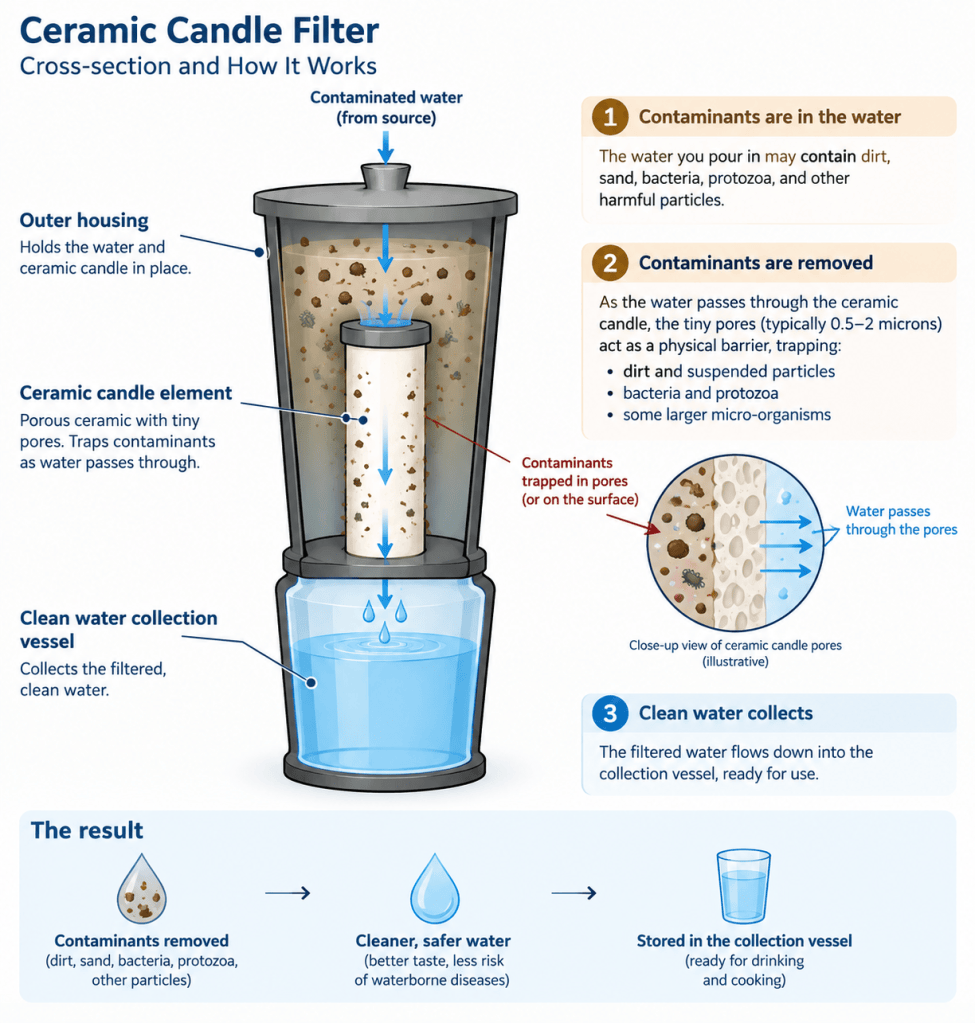
Ceramic filter has been noted to significantly reduce faecal coliform bacteria. A properly functioning ceramic filter does not require electricity, chemicals, or specialised technical knowledge to operate. It requires water poured in from the top, and cleaning of the ceramic element every few days with a soft brush under clean running water or whatever maintenance required for the filter in use.
The candle element itself has a lifespan. Ceramic filter candles should be replaced every six months under regular use — or at the start of each new semester in a student housing context — because the pores gradually become clogged with accumulated particles, reducing flow rate and eventually filtration effectiveness.
The Borehole Itself Needs Attention Too
An unencased or poorly encased borehole head allows surface water, including stormwater running across a compound during rain and wastewater moving through saturated soil, to enter the borehole directly or through the surrounding soil.
The distance between a borehole and the nearest source of contamination, a soakaway pit, an open drain, is one of the most direct predictors of water quality. Proper encasing of the borehole wellhead, combined with ensuring the area around it does not collect stormwater, is not a complex or expensive intervention. It is basic infrastructure maintenance with significant water quality consequences when skipped.
Why the Awareness Gap Is the Real Problem
People make health and safety decisions based on perceived risk. When water looks clear, the perceived risk of drinking it unfiltered is low and the cost and effort of filtering it feels disproportionate to the perceived benefit.
The solution is not more technical recommendations. It is better communication of what the technical recommendations are for. When someone understands that a candle filter costing less than ₦5,000 is the barrier between their drinking water and faecal bacteria, and that those bacteria are present whether the water looks clean or not, the calculation changes. When someone understands that the algae growth that discouraged them from using a filter previously was a maintenance error, not a product failure, they can try again correctly.
Water quality recommendations only protect people when they are implemented. And they are only implemented when the people receiving them understand not just what to do, but why it matters enough to actually do it.
Jay Water Advisory is committed to promoting sustainable water and environmental practices for communities across Nigeria and beyond.
 Jay water advisory
Leave a comment