By Jay Water Advisory
Knowing what can be in your borehole water is one thing. Knowing what is actually in yours requires taking action.
If you have not yet read our companion piece on what the key parameters in Nigerian borehole water are and why they matter, start there. It will help you understand what you are testing for before you test.
How to Get Your Water Tested — Three Practical Options
Option 1 — Accredited Laboratory Testing
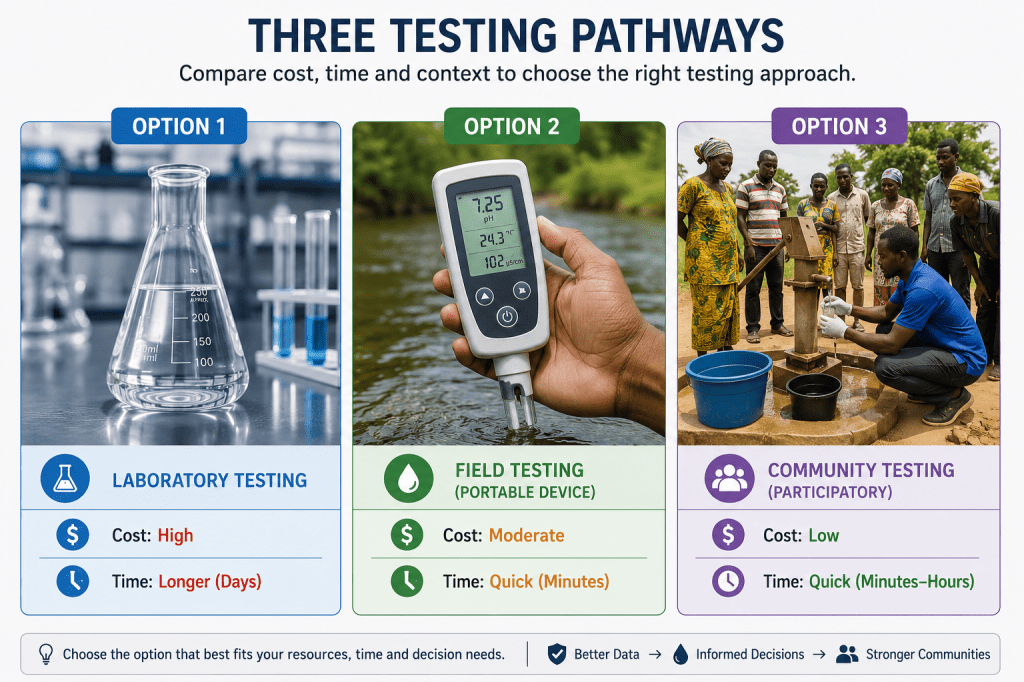
This is the gold standard for water quality testing. It works for households in urban areas. Water samples are collected in sterile bottles after the borehole pump has been left to run for at least two to three minutes. The water samples should be taken to an accredited facility within six hours of collection and kept cool to avoid degrading the water quality.
The samples would be analysed against WHO and Nigeria’s NSDWQ standards. Results typically cover both physicochemical parameters (pH, TDS, nitrates, iron, lead, manganese, and heavy metals) and microbiological parameters (total coliforms and E. coli). In major cities, accredited laboratories exist within public health agencies, universities, and private analytical firms.
Option 2 — Field Testing Kits
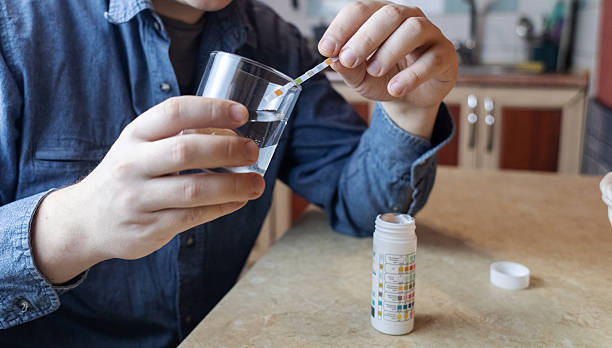
This works well for households in areas where laboratory access is difficult, expensive, or slow. Portable water testing kits are increasingly available in Nigeria through environmental supply companies and platforms like Jumia. These kits can measure pH, TDS, turbidity, nitrates, and, in some cases, total coliform presence directly at the point of collection without needing a laboratory.
They are less precise than laboratory analysis and cannot replace it for high-stakes decisions such as testing after suspected contamination or a major flooding event.
Option 3 — Community-Level Testing
This is more suited to rural communities where individual household testing is not financially feasible and a community borehole is shared accross several households. The cost of the testing can be shared across all users, making the per-household expense very manageable. Community leaders and water user associations can coordinate this directly with a local accredited laboratory, or make enquiries through WASH-focused organisations operating in the area.
For communities with no immediate testing access: While not a substitute for laboratory testing, the following physical observations provide useful warning signals that something may be wrong with a water source:
Water appearing cloudy or with any colour should be treated before use. A faint smell of rotten eggs suggests hydrogen sulphide from bacterial activity. An oily sheen on the surface indicates possible petroleum or chemical contamination. Water that tastes distinctly salty, bitter, or metallic warrants urgent testing before continued use. Any of these signs, especially after a flooding event, should be treated as a contamination signal until testing confirms otherwise.
For a household borehole, testing twice per year is recommended and after any major flooding event. At the start of the rainy season, when surface contamination risk peaks, and once during harmattan when water table levels are lowest and mineral concentration is highest.
What to Do With the Results
Results that come back within acceptable limits across all parameters are good news but not permanent reassurance. Water quality changes with seasons, with changes in the surrounding environment, and as borehole infrastructure ages. Regular testing remains important even when results are currently acceptable.
When results show contamination, which is more common than most households expect, the response depends on what was found.
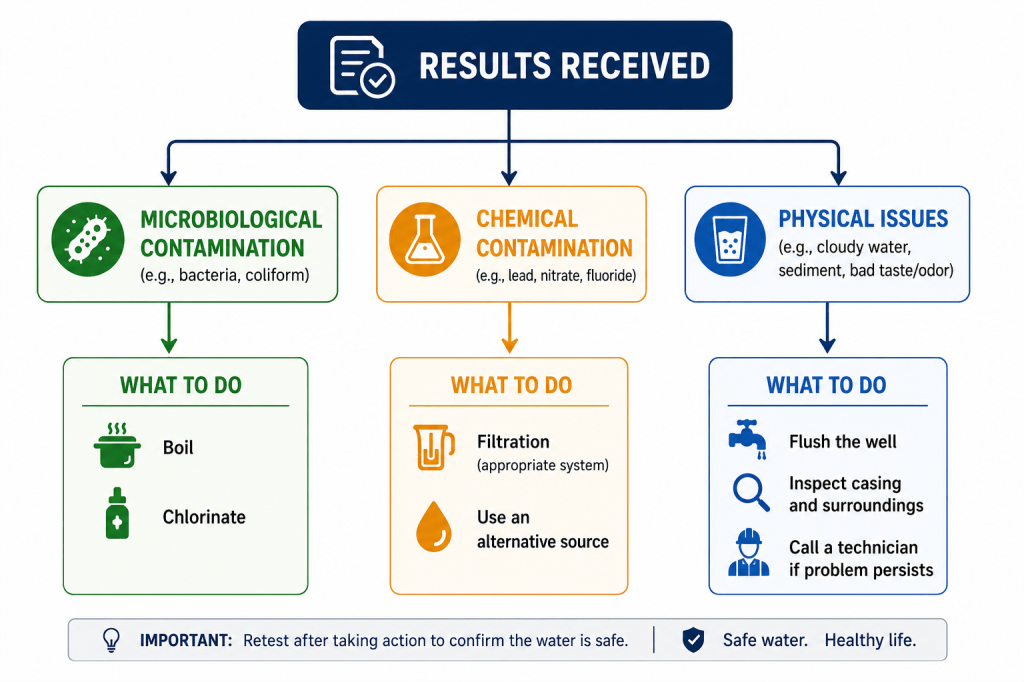
Microbiological contamination (coliform bacteria or E. coli) is addressed by boiling all water used for drinking and cooking. Chlorination using unscented household bleach (sodium hypochlorite) is an effective alternative for treating larger volumes, six drops per litre for clear water, twelve drops for turbid water, stirred and left to stand for 30 minutes before use.
Chemical contamination (nitrates, heavy metals, and elevated TDS) cannot be removed by boiling. These require filtration. Activated carbon filters or reverse osmosis systems can effectively remove a range of chemical contaminants. For households where investment in filtration is not currently feasible, using an alternative water source for drinking and cooking while continuing to use the borehole for other purposes is a practical interim step while saving toward a filtration solution.
Physical issues (persistent cloudiness, unusual colour, or odour) can often be resolved by cleaning and flushing the borehole, inspecting the casing for damage, and ensuring the wellhead cap is properly sealed.
The One Situation When Testing Is Non-Negotiable
Regardless of your location, income, or the duration of your borehole usage, there is one situation where testing is mandatory: after any flooding event that affects your compound or the surrounding area.
Floodwater carries faecal matter, chemicals, and pathogens that enter the groundwater system rapidly through saturated soil and compromised borehole casings. The risk is real, the contamination is invisible, and the health consequences are immediate.
A Final Word
Water quality testing is not something only laboratories and government agencies do. It is something every household with a borehole or well can and should engage with at whatever level their resources allow. Even a basic pH and TDS field kit used at the start of each rainy season provides more information than most Nigerian households currently have about the water they drink every day.
You would not eat food that smelled wrong without checking it. Your water deserves the same scrutiny.
Jay Water Advisory is committed to promoting sustainable water and environmental practices for communities across Nigeria and beyond.
 Jay water advisory
Leave a comment